
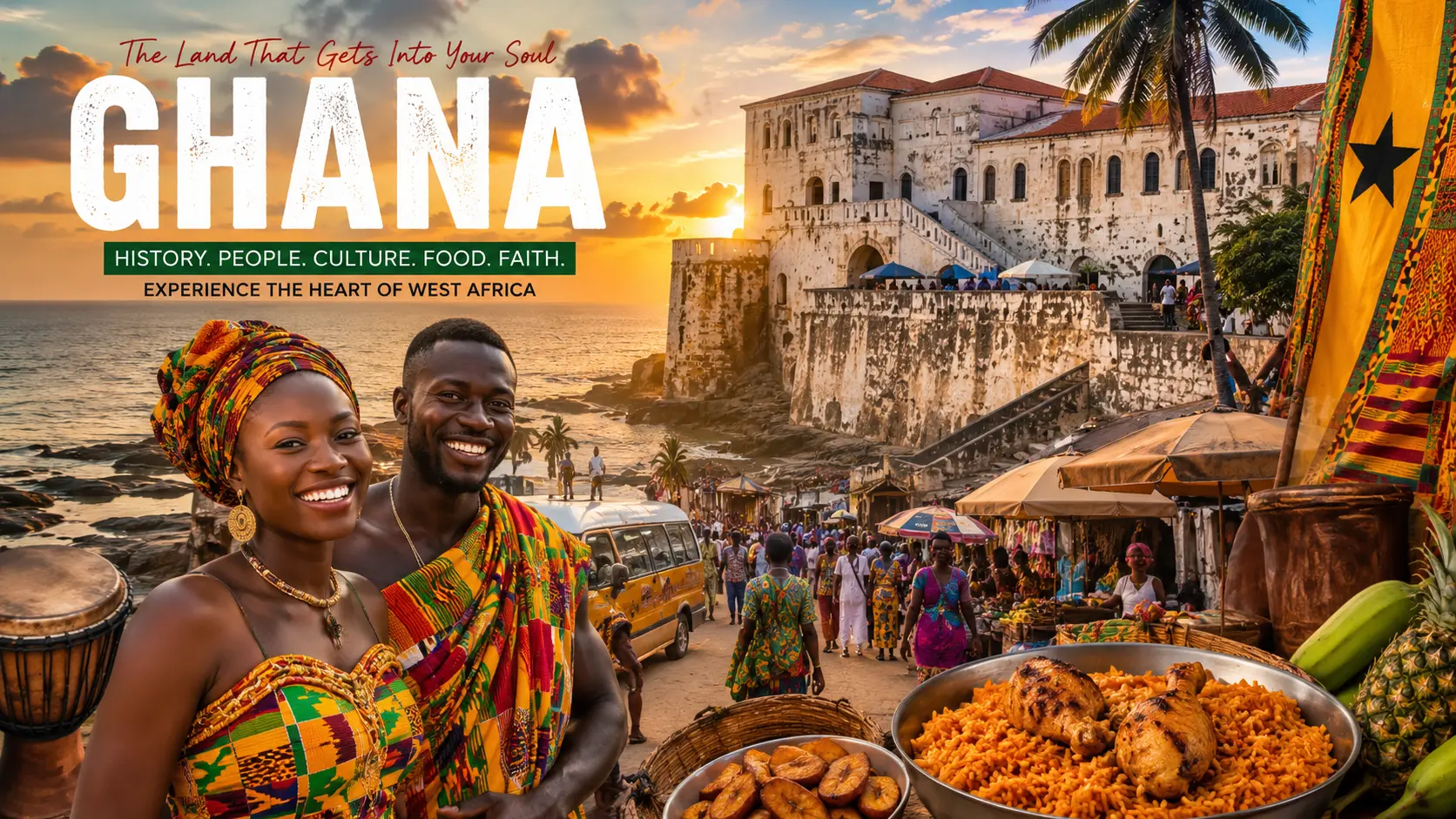
The complete guide to Ghana's history, people, food, education, religion, and why this West African gem deserves a spot on your bucket list.
There's a moment that happens to almost every visitor to Ghana. It's usually somewhere between stepping off the plane and finishing their first plate of jollof rice. Something shifts. The heat wraps around you like a blanket, someone smiles at you for no reason at all, and you think — okay, I get it now.
Ghana has a way of doing that. It doesn't just welcome you. It pulls you in.This is a country that has seen empires rise and fall, survived one of the darkest chapters in human history, and come out the other side with its spirit not just intact — but vibrant, proud, and deeply alive. If you're thinking about visiting West Africa, Ghana isn't just a good choice. For many travelers, it's the best choice.
Let us take you through everything that makes this place so special.A History That Runs Deeper Than You Think
Ghana's story didn't start when Europeans arrived on its shores. Long before any colonial presence, this land was home to some of the most powerful and sophisticated kingdoms in Africa.The most famous of these was the Ashanti Empire, centered in what is now Kumasi. The Ashanti were a force — militarily strong, culturally rich, and governed by a complex system of chiefs and councils that many modern democracies could honestly learn from. Their golden stool, the Sika Dwa, wasn't just a throne. It was believed to hold the very soul of the Ashanti people. The British tried to take it once. They failed, badly, and the attempt sparked a war.
Before the Ashanti, there was the Ghana Empire — which, interestingly, wasn't even located in present-day Ghana, but further north in modern Mali and Mauritania. When the newly independent nation was searching for a name in 1957, they chose "Ghana" as a tribute to that ancient greatness. It was a statement: we are not starting from nothing. We come from somewhere.
Then came the Portuguese in the late 1400s, followed by the Dutch, the Danes, the Swedes, and eventually the British. They built forts and castles along the coast — many of which still stand today — and for over two centuries, the Gold Coast (as it was then known) became a major hub of the transatlantic slave trade. An estimated 10 to 12 million Africans were shipped across the ocean through ports like Cape Coast and Elmina. When you stand in the dungeons of those castles today, it doesn't feel like history. It feels like yesterday.
But here's the part of the story that doesn't get told enough: Ghana fought back. Chiefs resisted. Communities refused. And eventually, on March 6, 1957, Ghana became the first sub-Saharan African country to gain independence from colonial rule, led by the brilliant and complicated Kwame Nkrumah, a man who dreamed not just of a free Ghana, but of a united Africa.
That day sent a ripple across the entire continent. If Ghana could do it, everyone could.